
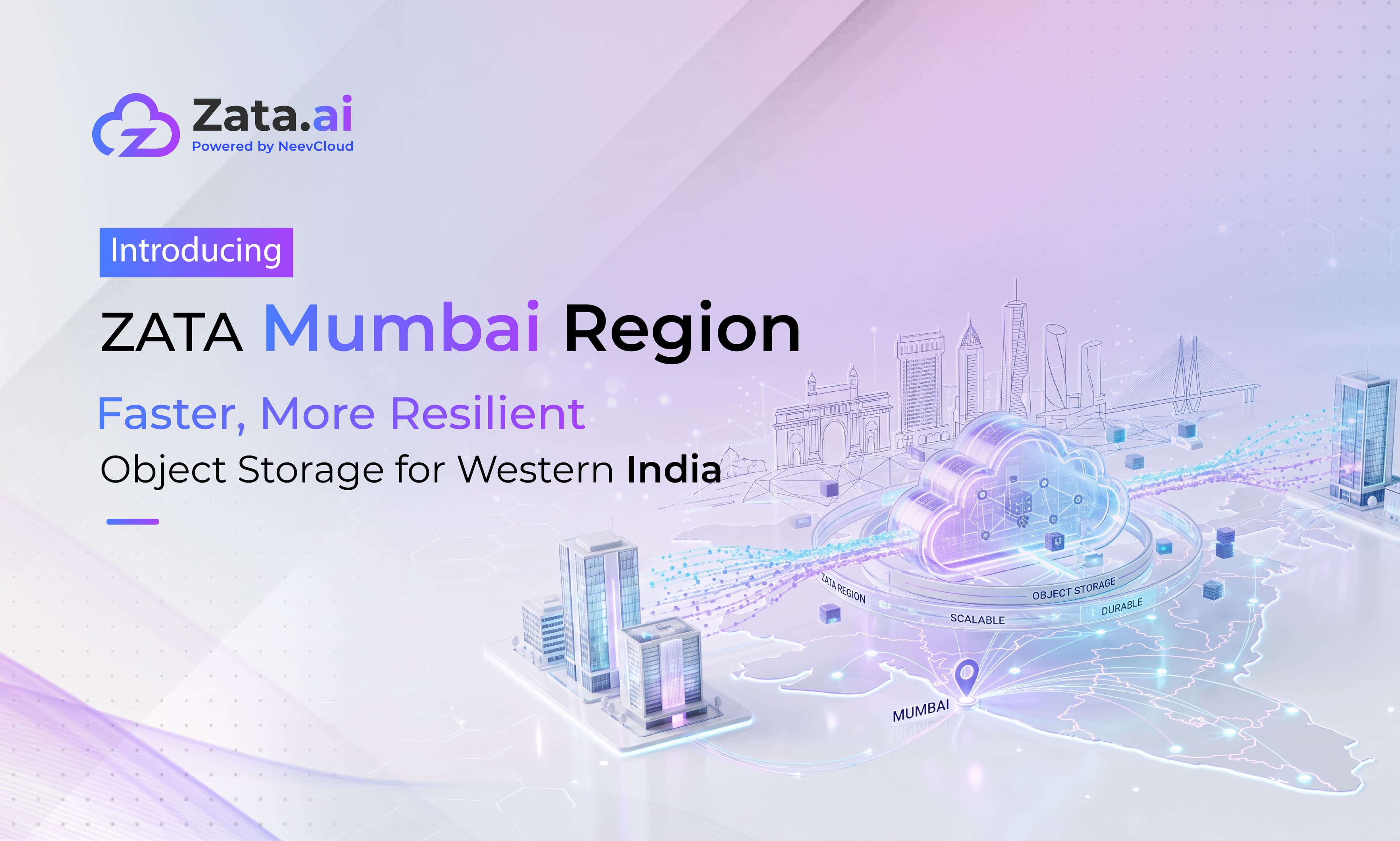
Introducing ZATA Mumbai Region: Faster, More Resilient Object Storage for Western India
TL;DR:
ZATA now runs a Mumbai region for object storage, extending beyond Indore into Western India.
The region is built on a high availability architecture with Tier IV certified infrastructure and enterprise grade encryption.
Multi-region object storage gives businesses disaster recovery and business continuity without re-architecting applications.
S3-compatible APIs mean existing SDKs, tooling, and workflows carry over with zero migration friction.
Choose Mumbai for high availability and Western India proximity, Indore for latency-sensitive Central India workloads, or run both for redundancy.
Why Data Location Matters More Than Ever
Enterprises are no longer choosing cloud storage on price alone. Where data physically lives now shapes application latency, regulatory posture, and how fast a business recovers from an outage. As AI teams, media companies, and fintechs scale their datasets, demand for a dependable storage region in India has grown well past what a single location can support.
Compliance adds another layer. Data residency requirements under India's evolving regulatory landscape push enterprises to keep sensitive data within the country, and increasingly, within a specific region that matches where their customers and operations are based. A single storage region also creates a single point of failure. If that region goes down, so does the business built on top of it.
Introducing the ZATA Mumbai Region
Overview
ZATA is expanding its object storage footprint with a new region in Mumbai, adding to its existing Indore region. This gives customers a true multi-region cloud object storage platform inside India, with S3-compatible object storage available from both locations.
Why Mumbai
Mumbai is India's financial and media capital, home to a dense concentration of enterprises, fintech companies, and content platforms. Placing a storage region here cuts the distance between application servers and the data they depend on for a large share of India's digital economy.
Designed for Western India
The Mumbai region is built to serve businesses operating across Western India, from Mumbai and Pune to Ahmedabad and Surat, giving them a nearby, high-availability alternative to routing storage traffic across the country or offshore.
What Makes the Mumbai Region Different?
High availability architecture: data is distributed across redundant infrastructure to stay accessible even during hardware failures.
Enterprise-grade encryption: data is encrypted at rest and in transit, meeting the bar enterprise security teams expect.
Long-term data durability: object storage designed to protect against silent data loss over years, not just months.
Tier IV certified infrastructure: the highest tier of datacenter fault tolerance, built for workloads that cannot tolerate downtime.
Compliance-ready storage: architecture that supports data residency and regulatory requirements for Indian enterprises.
Built for Modern Data-Intensive Workloads
The Mumbai region is purpose-built for the workloads generating the most data growth today:
AI and Machine Learning: training datasets, model checkpoints, and inference logs that need durable, high-throughput object storage.
Media and Entertainment: large video and image libraries that require fast uploads and downloads at scale.
FinTech: transaction records and audit data that demand security, durability, and data residency in India.
SaaS Platforms: customer data and application assets that need to stay close to users for performance.
Enterprise Backup and Archiving: long-term retention that depends on durability over years, not uptime alone.
Benefits of Multi-Region Object Storage
Lower latency for applications and users located closer to Western India.
Disaster recovery through geographically separated storage regions.
Business continuity if one region experiences disruption.
A better user experience through faster uploads and downloads.
Regional data residency that supports compliance requirements.
Mumbai vs Indore Region: Which One Should You Choose?
Both regions run on the same S3-compatible object storage platform. The right choice depends on where your users and workloads are concentrated, and whether you need one region or both.
Feature | Mumbai Region | Indore Region | Best For |
Primary strength | High availability | Low latency | Match to workload |
Primary audience | Western India | Central India | Regional proximity |
Ideal workloads | Media, AI, Enterprise | Analytics, AI, Local apps | Workload type |
Disaster recovery | Excellent | Excellent | Multi-region pairing |
Enterprises with a national footprint often don't have to choose. Running workloads across both regions is what turns object storage from a single dependency into a resilient, multi-region architecture.
Why Developers and Enterprises Need Regional Storage
Application performance improves when storage sits physically closer to compute and users.
Faster uploads and downloads reduce wait times for media-heavy and data-intensive applications.
Scalability lets teams grow storage independently in the region that matches demand.
Cost optimization comes from routing traffic efficiently instead of paying for cross-region transfer by default.
Future-Proof Your Data with ZATA Multi-Region Storage
The Mumbai region is designed to work alongside Indore, not replace it. Enterprises can use both regions together for hybrid deployments, keeping primary workloads in one region while replicating critical data to the other as part of a deliberate redundancy strategy.
This approach lets a business scale storage geographically as its customer base grows, without rebuilding its architecture every time it enters a new market.
Get Started with the ZATA Mumbai Region
Provision S3-compatible object storage in Mumbai today, or pair it with the Indore region for a true multi-region architecture built for AI, media, fintech, and enterprise workloads.
Start with ZATA Object Storage
Talk to our team about multi-region architecture today.